
Does every new home in Edmonton automatically come with warranty coverage?No. Alberta law requires a builder to register a home for warranty coverage before construction starts, but that coverage

Dated: August 22 2026
Views: 48
A restrictive covenant is a private legal agreement registered on a property's title that can limit what gets built on a neighbouring lot — including height, use, or lot configuration — even where the City's Zoning Bylaw would otherwise allow it. In Edmonton, a small but growing number of homeowners in mature neighbourhoods are registering covenants, sometimes as a group, specifically to head off multiplex or oversized infill next door. They can work, but only where the affected landowner agrees and a real estate lawyer drafts and registers them correctly — and they don't override the City's own rules, like the Mature Neighbourhood Overlay's new 9.5-metre infill height cap that took effect August 1, 2026. A covenant layers on top of the public rules; it doesn't replace them.
By Shane Parent | August 21, 2026
If you've seen the story about the Duggan-area homeowner who bought the house next door outright rather than risk a multiplex going up beside them, or the one about a group of south Edmonton neighbours who registered a joint restrictive covenant against tall infill, you're not imagining a trend. Homeowners across Edmonton's mature communities are getting proactive — sometimes aggressively so — about controlling what gets built beside them. If you own, or want to buy, in a neighbourhood like Capilano, Forest Heights, Fulton Place, Gold Bar, or Terrace Heights, this is worth understanding before you make your next move.
A restrictive covenant is a private contract between landowners, registered against the title of a specific piece of land. Once it's registered, it "runs with the land," meaning it binds future owners too, not just the person who signed it. That's what makes it different from a handshake agreement with a neighbour — it shows up on a title search and on the property's Real Property Report (RPR) for as long as it stays on title.
Here's the part people miss: a covenant only restricts the lot it's registered against, and only with that lot owner's agreement. You can't unilaterally impose a covenant on your neighbour's property to stop them from building. That's why the Duggan story got so much attention — buying the house outright was the only way that particular homeowner could guarantee control over what got built there. In the south Edmonton case, it took a group of neighbours negotiating together, lot by lot, to build a covenant that covered enough of the block to matter.
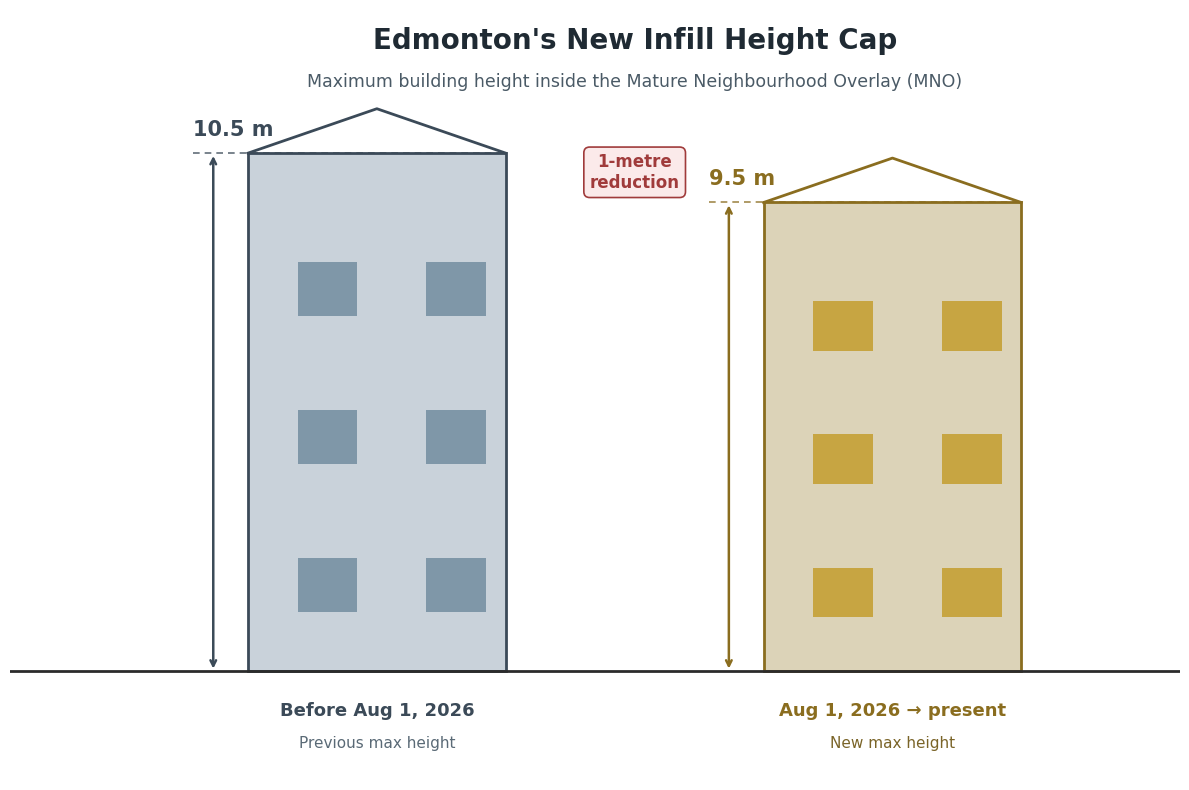
A covenant also sits on top of the City's public rules — it doesn't replace them. Edmonton's Mature Neighbourhood Overlay (layered onto the citywide Zoning Bylaw 20001) already sets baseline limits for infill design in communities like these: setbacks, streetscape requirements, and now a reduced maximum height. As of August 1, 2026, that height cap dropped from 10.5 metres to 9.5 metres for infill in mature and redeveloping neighbourhoods inside the Anthony Henday — which covers all five of the communities named above. A restrictive covenant can go further than that public baseline (tighter height limits, use restrictions, a cap on the number of units), but it can never be used to permit something the Zoning Bylaw and MNO don't already allow.
Three things are converging in Edmonton right now, and together they explain why covenants have gone from a niche legal tool to something homeowners are actively discussing.
First, the height cap change itself. Council's move to 9.5 metres was meant to ease pressure on mature streets, but plenty of owners feel it doesn't go far enough to protect sightlines, privacy, or the character of a block — especially on narrower lots.
Second, uncertainty about what comes next. Council has been through several rounds of intense debate over the pace of infill and zoning changes — a councillor's attempt at an infill moratorium failed for legal reasons, and council has, at different points, voted to hold the line on existing requirements after long public hearings. That back-and-forth leaves both buyers and sellers unsure what will be permitted on a given lot a year or two from now. A registered covenant is one of the few tools that gives an owner certainty the public rules alone can't.
Third, and probably the most emotionally charged piece: complaints about how some existing infill and row housing are actually being used. The City is separately reworking its lodging house and short-term rental rules after residents complained about high-turnover row housing — some units effectively operating like unlicensed hotels, rented by the day or even the hour. Concrete proposals are expected this fall. For someone who already lives beside an infill property, that's a very different worry than height and setbacks — it's about who's coming and going next door, night after night.
None of this means covenants are right for everyone, or that they're simple to set up. But it explains why more owners in communities like Capilano, Forest Heights, Fulton Place, Gold Bar, and Terrace Heights are asking about them.
If you're staying put, a covenant (or the absence of one) is mostly a resale question. Buyers shopping in mature neighbourhoods right now are increasingly savvy about infill risk — they're asking what could be built on the vacant or aging bungalow lot next door, and whether anything protects against it. A registered covenant can be a genuine selling point if your street has one. Where there isn't one, that's simply the reality of buying in a mature, redeveloping community, and it's worth being upfront about with buyers rather than letting it surface as a surprise during their own due diligence.
If you're actively considering registering a covenant — on your own lot, or as part of a group of neighbours — a few things to know going in:
None of that is legal advice — for the actual drafting, registration, and Dower Act question, that conversation belongs with your lawyer. What I can help with is the real estate side: what a covenant (or its absence) actually means for how your home shows and prices in today's market, and whether the effort is proportional to the risk on your specific street. If you're weighing whether to sell now, wait, or pursue a covenant first, my Edmonton Home Sellers Guide is a good starting point on the broader listing decision.
If you're house-hunting in one of these mature communities and you've fallen for a home next to an older bungalow, a large lot, or a visibly aging property, it's worth asking a few questions before you write an offer:
And if you're the one buying the vacant or redevelopable lot to build new construction yourself, the same rules cut the other way: your project has to fit inside the 9.5-metre cap and the MNO's other design requirements, and you'll want to know before you close whether any covenant already sits on that title limiting what you can do with it.
This is exactly the kind of question worth walking through with someone who works these specific streets — the public rules only tell you part of the story, and the rest is local knowledge.
Does a restrictive covenant cost anything to register in Edmonton?
Yes. Because a lawyer needs to draft and register the covenant against title, costs typically include legal fees plus Land Titles registration charges, and they scale with how many properties and owners are involved. Ask your lawyer for a specific quote based on your street's situation.
Can I put a restrictive covenant on my neighbour's property without their agreement?
No. A covenant only restricts a property when that property's owner agrees to be bound by it — you can't impose one unilaterally on land you don't own or control. That's why some owners have instead chosen to buy the neighbouring lot outright, or to negotiate covenants collectively with several neighbours at once.
Does the new 9.5-metre infill height cap apply to my street?
The reduced cap applies to infill in mature and redeveloping neighbourhoods inside the Anthony Henday, which includes communities like Capilano, Forest Heights, Fulton Place, Gold Bar, and Terrace Heights. It took effect August 1, 2026. Your specific lot's zoning and any overlay requirements are worth confirming directly, since design rules can vary by exact site.
Will a restrictive covenant show up on a Real Property Report or title search?
Yes. A properly registered covenant appears on a title search and should be reflected in the property's Real Property Report. That's part of what makes it enforceable against future owners, and it's exactly what a buyer's due diligence should be checking for.
Do I need a lawyer to figure out if the Dower Act applies to my situation?
Yes. If a property is jointly used by a married couple but only one spouse is on title, Alberta's Dower Act can require the non-owner spouse's consent for certain transactions, including some covenant arrangements. This is a legal question specific to your situation, so it belongs with your real estate lawyer, not a general guide like this one.
If you're thinking through what any of this means for your own street, your own listing, or a property you're considering buying, I'm happy to walk through the specifics with you. Reach out anytime.
About Shane Parent
Shane Parent is a broker-owner at REMAX River City and leader of the Platinum Team, serving Edmonton and area since 2003. He holds his Accredited Buyer's Representative (ABR), Seller Representative Specialist (SRS), Senior Real Estate Specialist (SRES), and Certified Negotiation Expert (CNE) designations, has personally helped over 550 families buy, sell, and invest in real estate, and oversees close to 5,000 transactions annually across the brokerage. Shane and his team are known for fast response times and a genuine commitment to client service.

Shane’s focus is on Associate support and development through one-on-one coaching. He brings a wealth of knowledge, resources and fun to helping Associates achieve their goals. He also offers specia....
Does every new home in Edmonton automatically come with warranty coverage?No. Alberta law requires a builder to register a home for warranty coverage before construction starts, but that coverage
Who pays a special assessment on a condo in Edmonton — the buyer or the seller?Under Alberta's standard resale condominium purchase contract, the answer comes down to timing, not need. The
Can a restrictive covenant stop infill development next door in Edmonton?A restrictive covenant is a private legal agreement registered on a property's title that can limit what gets built on a
Spring in Edmonton is just around the corner, and with it comes the busiest season in real estate. As the snow begins to melt and listings start to rise, many buyers automatically assume that
 Copyright 2026 by the REALTORS® Association of Edmonton. All rights reserved.
Data is deemed reliable but is not guaranteed accurate by the REALTORS® Association of Edmonton.
The trademarks REALTOR®, REALTORS® and the REALTOR® logo are controlled by The Canadian Real Estate Association (CREA) and identify real estate professionals who are members of CREA. The trademarks MLS®, Multiple Listing Service® and the associated logos are owned by CREA and identify the quality of services provided by real estate professionals who are members of CREA. Used under license.
Information last updated on September 11, 2026 9:20 PM UTC
Copyright 2026 by the REALTORS® Association of Edmonton. All rights reserved.
Data is deemed reliable but is not guaranteed accurate by the REALTORS® Association of Edmonton.
The trademarks REALTOR®, REALTORS® and the REALTOR® logo are controlled by The Canadian Real Estate Association (CREA) and identify real estate professionals who are members of CREA. The trademarks MLS®, Multiple Listing Service® and the associated logos are owned by CREA and identify the quality of services provided by real estate professionals who are members of CREA. Used under license.
Information last updated on September 11, 2026 9:20 PM UTC