
Does every new home in Edmonton automatically come with warranty coverage?No. Alberta law requires a builder to register a home for warranty coverage before construction starts, but that coverage

Dated: August 28 2026
Views: 16
Under Alberta's standard resale condominium purchase contract, the answer comes down to timing, not need. The seller pays any special assessment passed by board resolution on or before 12 noon on the completion day. The buyer becomes responsible for anything decided after that. That means you can close on a condo, move your furniture in, and still get hit with a five-figure bill weeks later if the board votes on it after that cutoff — which is exactly why reviewing the reserve fund study before you waive your condo document condition matters more than almost anything else in the deal.
By Shane Parent | August 28, 2026
Edmonton condo owners have been hit with special assessments ranging from $9,000 to $45,000 with almost no warning. If you're shopping for a condo anywhere in the $400K–$800K range in this city — or you already own one and you're thinking about selling — this is the question that should come before "what are the condo fees," not after.
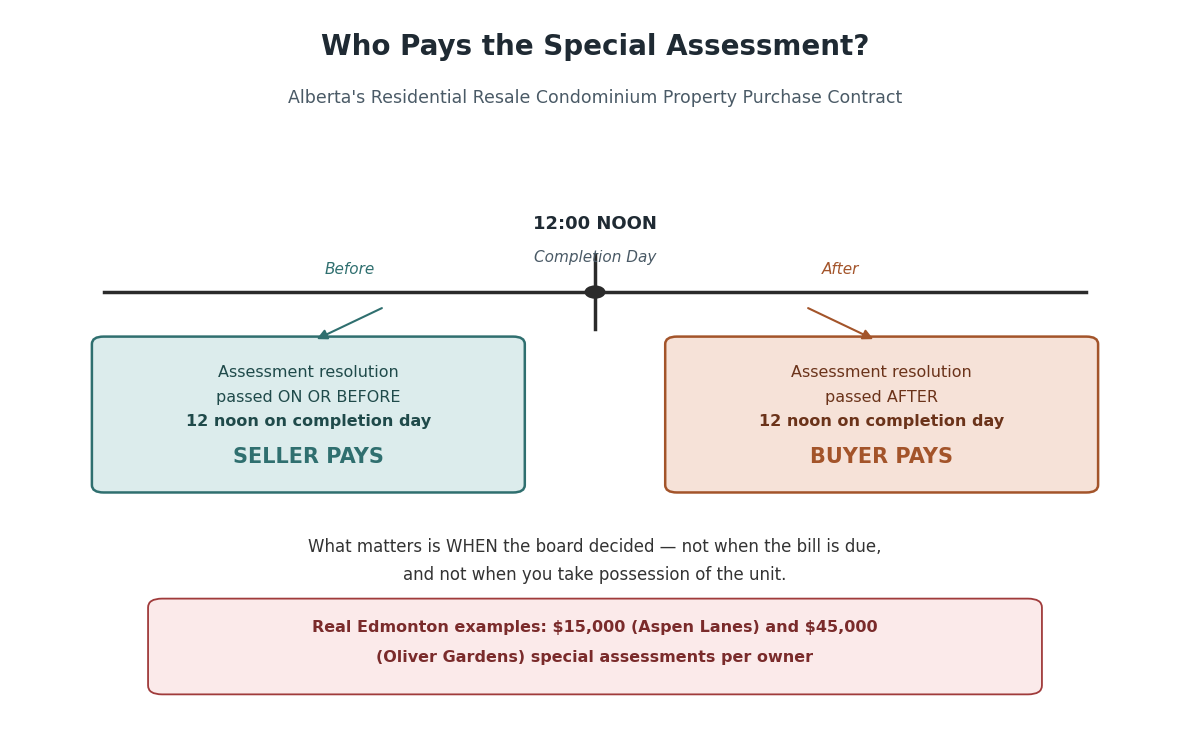
Here's what most buyers don't know until it's too late: Alberta's Residential Resale Condominium Property Purchase Contract has a specific clause that allocates special assessment responsibility, and it hinges entirely on when the assessment was decided, not when it needs to be paid.
That single time-of-day cutoff is why two buyers in the identical unit, closing two days apart, can end up on opposite sides of a $20,000 bill. It's also why a seller can't simply avoid disclosure by staying quiet about a vote that hasn't happened yet — because if it happens even one day after your completion, the obligation is already yours by contract, whether anyone warned you or not.
This is a Process question, not a Property one, and it belongs in your Alberta real estate lawyer's lap before you sign anything. But knowing the clause exists, and knowing exactly what to ask for, is what lets you catch a problem before you're contractually stuck with it.
This isn't a hypothetical. It's happened here, more than once, and the numbers are real.
At one Edmonton condo development, fifty homeowners were hit with a $15,000 special levy each after the developer had structured the project through a separate numbered company — a legal move that limited the developer's liability for unfinished grading, landscaping, road paving, and roof and window leaks. One owner had bought his duplex for $370,000, received the levy notice three months later, and had to sell a vehicle and dip into retirement savings to cover it. "It's horrible," he said. "It's unbelievable a company can do this to consumers and get away with it."
At Oliver Gardens, a roughly 50-unit Edmonton building built in 1980, the parkade, roof, and foundation had all reached the end of their functional life. The board levied an average $45,000 special assessment per owner, due by a fixed date, with two options: pay in full or take a 20-year condo corporation loan that would run close to $95,000 with interest by the time it was paid off. "It's heartbreaking, honestly," one owner said. "I really feel powerless right now." Another described his reaction to the notice bluntly: "The first reaction was, I almost threw up." His bank had already turned down his refinancing application, and he worried about what it meant for the seniors in the building facing the same bill.
Those are extreme cases, but the pattern behind them is common: aging mechanical systems, roofs, and building envelopes that the reserve fund didn't fully anticipate, discovered only after a formal inspection or a failure forces the board's hand.
If you're actively shopping for a condo in Edmonton right now, here's what actually protects you — none of it is complicated, but almost none of it is optional if you want to avoid becoming the next Oliver Gardens story:
None of this is legal advice, and it isn't meant to be — your lawyer is the one who confirms the actual completion time and reviews the contract language for your specific deal. What I can do is flag exactly which documents to request and which questions to ask before you're past your condition date, so you and your lawyer aren't reviewing this for the first time under a deadline.
If you own a condo and there's been any recent talk of major repairs — even informal talk, even nothing formally voted on yet — it's worth getting ahead of it before you list. Buyers and their lawyers are asking these questions more carefully than they used to, and a board resolution that lands after you accept an offer but before completion can complicate or even unwind a deal. My Edmonton Home Sellers Guide covers the broader listing-prep picture, but a condo with a possible assessment on the horizon deserves a conversation of its own before it ever hits the market.
Does it matter if a special assessment is decided after I've already taken possession of the condo?
Yes. Responsibility is based on when the board passed the resolution relative to 12 noon on your completion day — not on when you took possession, and not on when the assessment is actually due. You can be living in the unit and still be contractually clear of an assessment voted on before that cutoff, or on the hook for one voted on after it.
What is a reserve fund study, and how do I get one before buying an Edmonton condo?
A reserve fund study is a professional assessment of a condo building's major components — roof, parkade, mechanical systems, and similar — and when they're expected to need replacement, along with whether the current reserve fund is on track to cover it. Your realtor or lawyer can request it from the condo corporation as part of your document review during the purchase.
Can I back out of buying a condo if I discover a large anticipated special assessment?
That depends entirely on the conditions written into your specific purchase contract, including your condo document review condition and its deadline. This is a question for your real estate lawyer as soon as you see anything concerning in the reserve fund study or meeting minutes — timing matters, and it's usually tight.
Are older condo buildings in Edmonton more likely to hit owners with a special assessment?
Age is a real factor, since roofs, parkades, and mechanical systems all have a functional lifespan, and older buildings are more likely to be approaching it. That said, newer buildings aren't automatically safe — construction deficiencies in relatively new developments have led to special assessments in Edmonton as well.
Does a special assessment show up on title or in a standard home inspection?
No. A special assessment is a financial decision made by the condo corporation's board, not a registered interest on title, and a standard home inspection typically covers the unit itself, not the building's shared financial position. The reserve fund study and condo document package are where this information actually lives.
If you're thinking through a condo purchase or sale in Edmonton and want a second set of eyes on the reserve fund study before you're past your conditions, I'm happy to walk through it with you. Reach out anytime.
About Shane Parent
Shane Parent is a broker-owner at REMAX River City and leader of the Platinum Team, serving Edmonton and area since 2003. He holds his Accredited Buyer's Representative (ABR), Seller Representative Specialist (SRS), Senior Real Estate Specialist (SRES), and Certified Negotiation Expert (CNE) designations, has personally helped over 550 families buy, sell, and invest in real estate, and oversees close to 5,000 transactions annually across the brokerage. Shane and his team are known for fast response times and a genuine commitment to client service.

Shane’s focus is on Associate support and development through one-on-one coaching. He brings a wealth of knowledge, resources and fun to helping Associates achieve their goals. He also offers specia....
Does every new home in Edmonton automatically come with warranty coverage?No. Alberta law requires a builder to register a home for warranty coverage before construction starts, but that coverage
Who pays a special assessment on a condo in Edmonton — the buyer or the seller?Under Alberta's standard resale condominium purchase contract, the answer comes down to timing, not need. The
Can a restrictive covenant stop infill development next door in Edmonton?A restrictive covenant is a private legal agreement registered on a property's title that can limit what gets built on a
Spring in Edmonton is just around the corner, and with it comes the busiest season in real estate. As the snow begins to melt and listings start to rise, many buyers automatically assume that
 Copyright 2026 by the REALTORS® Association of Edmonton. All rights reserved.
Data is deemed reliable but is not guaranteed accurate by the REALTORS® Association of Edmonton.
The trademarks REALTOR®, REALTORS® and the REALTOR® logo are controlled by The Canadian Real Estate Association (CREA) and identify real estate professionals who are members of CREA. The trademarks MLS®, Multiple Listing Service® and the associated logos are owned by CREA and identify the quality of services provided by real estate professionals who are members of CREA. Used under license.
Information last updated on September 9, 2026 9:04 PM UTC
Copyright 2026 by the REALTORS® Association of Edmonton. All rights reserved.
Data is deemed reliable but is not guaranteed accurate by the REALTORS® Association of Edmonton.
The trademarks REALTOR®, REALTORS® and the REALTOR® logo are controlled by The Canadian Real Estate Association (CREA) and identify real estate professionals who are members of CREA. The trademarks MLS®, Multiple Listing Service® and the associated logos are owned by CREA and identify the quality of services provided by real estate professionals who are members of CREA. Used under license.
Information last updated on September 9, 2026 9:04 PM UTC